
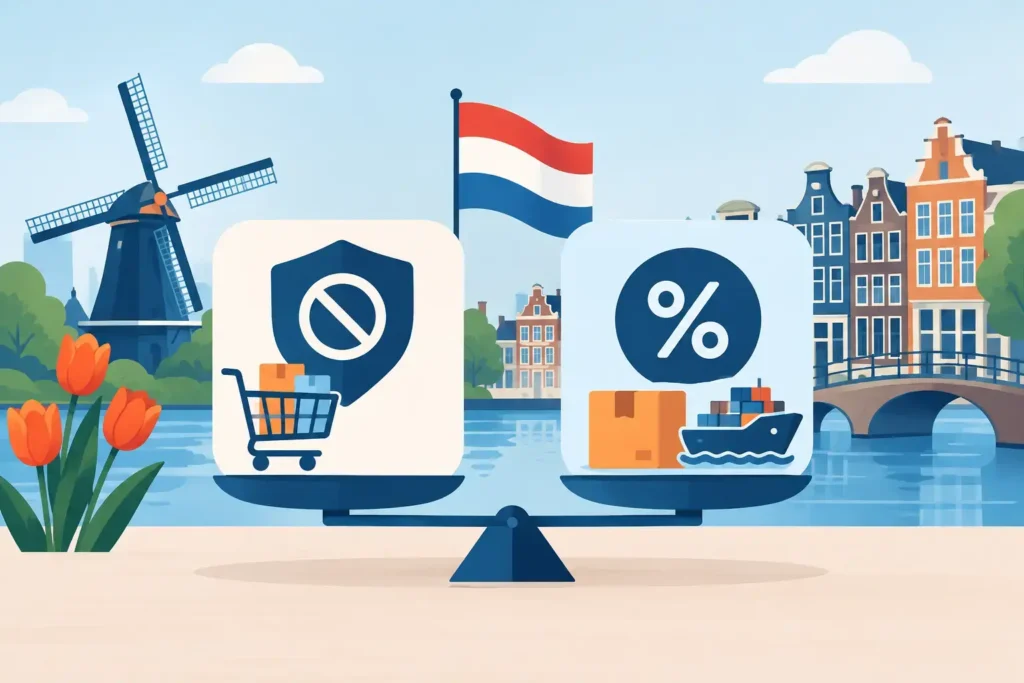
A sale can generate no VAT on the customer’s invoice for two very different reasons. In the Netherlands, the distinction between VAT exemption versus zero rate directly affects whether your business can recover VAT on its costs. Getting it wrong can turn a seemingly minor classification decision into an unexpected expense, a correction on a VAT return, or both.
For entrepreneurs, internationally active companies and businesses new to Dutch VAT, the practical question is not simply, “Do I charge VAT?” It is, “What is the legal treatment of this supply, what evidence must I retain, and can I deduct the VAT I pay to suppliers?”
VAT exemption versus zero rate: the commercial difference
A zero-rated supply is taxable for VAT purposes, but VAT is charged at 0%. The transaction remains within the VAT system. This generally means the supplier retains the right to deduct input VAT relating to that supply.
An exempt supply is treated differently. No VAT is charged to the customer, but the supplier will usually not be entitled to recover input VAT connected with the exempt activity. The VAT paid on professional fees, equipment, rent, software or other purchases may therefore become a real cost to the business.
This is why two invoices that both show no VAT can have entirely different financial outcomes. Zero rating is often beneficial where substantial costs support the activity. Exemption may simplify the customer-facing invoice, but it can reduce VAT recovery and influence pricing, margins and investment decisions.
When does the Dutch zero rate apply?
The 0% VAT rate does not apply because a business prefers not to charge VAT. It applies only where Dutch VAT law provides for it and where the relevant conditions are met.
Common examples include the export of goods from the Netherlands to a destination outside the EU and certain intra-Community supplies of goods to VAT-registered business customers in another EU Member State. Some international transport-related supplies may also qualify. The exact treatment depends on what is supplied, where it is supplied, who receives it and how the movement of goods can be evidenced.
For an intra-Community supply, a valid VAT number for the customer is only one part of the picture. The supplier must also be able to demonstrate that the goods actually left the Netherlands for another EU country. Transport documents, customer confirmations, order records and payment evidence can all be relevant. If the evidence is incomplete, the Dutch Tax and Customs Administration may challenge the zero rate and assess Dutch VAT, potentially with interest and penalties.
Exports require similarly careful documentation. A goods export is not automatically zero-rated merely because the customer is established outside the EU. The supplier must be able to show that the goods physically left the EU within the applicable requirements.
Zero rate is not the same as reverse charge
This distinction matters particularly for cross-border service providers. Many B2B services supplied to a business customer in another country are subject to the reverse-charge mechanism rather than the zero rate. In that case, the customer accounts for VAT in its own country, while the Dutch supplier issues an invoice stating that VAT has been reverse charged.
The invoice wording, VAT return treatment and reporting obligations can differ. For EU B2B services, an EC Sales List may also be required. Treating every cross-border invoice as “0% VAT” is a frequent and avoidable compliance error.
Which activities may be VAT-exempt?
VAT exemptions apply to defined categories of supplies, not to a general type of business or customer. In the Netherlands, exemptions can apply to areas such as qualifying medical care, education, insurance, financial services, certain cultural or social activities, and particular property transactions or leases.
The detail matters. For example, medical services may be exempt when their principal purpose is the protection, maintenance or restoration of human health. A service supplied by a healthcare professional does not necessarily qualify just because it is health-related. Likewise, education is not automatically exempt because a course is informative or professionally useful. The provider, content, purpose and statutory conditions must be considered.
Property creates another area where assumptions can be costly. The letting of immovable property is often exempt, but exceptions and options to tax can apply in specific circumstances. A decision about VAT on commercial premises may affect the recoverability of VAT on renovation, fit-out and operating costs for years.
Financial and insurance businesses also need to distinguish carefully between exempt core transactions and taxable support, administration, consultancy or technology services. Labelling an invoice by reference to an industry does not determine its VAT treatment. The actual nature of the service does.
Input VAT recovery is usually the deciding factor
A business making zero-rated supplies can generally recover the VAT it incurs on costs that relate to those supplies, provided the usual deduction conditions are met. This keeps VAT neutral for the supplier, which is the intended effect of the VAT system.
A business making exempt supplies generally cannot deduct related input VAT. For example, if an exempt provider pays VAT on office equipment, marketing, accounting fees or specialist software, that VAT may remain embedded in its costs. It should be reflected in budgets and pricing rather than assumed to be recoverable through the VAT return.
Businesses with both taxable and exempt activities require more detailed analysis. They may have to allocate costs directly to taxable or exempt activities and apply a partial exemption method to shared overheads. A business-wide turnover-based calculation is common, but it is not always the fairest or most accurate method. Where it produces an unreasonable result, another method may be considered, subject to the relevant rules and evidence.
This issue often emerges during growth. A consultancy may begin with fully taxable advisory work, then add exempt financial services or training. An investor may acquire a property with an intended taxable use that later changes. The VAT position should be reviewed before contracts are signed, not only when the quarterly return is prepared.
Invoicing and records must reflect the correct treatment
A zero-rated invoice should clearly show the 0% rate and meet normal Dutch invoicing requirements. More importantly, the business needs a file that supports why the rate was used. For goods supplied across borders, that file should be built as the transaction takes place, rather than reconstructed months later during a tax review.
For an exempt supply, the invoice should make clear that VAT is not charged because the supply is exempt. Depending on the circumstances, it may be appropriate to refer to the applicable exemption. Clear invoice descriptions are valuable because they allow customers, finance teams and tax authorities to understand the treatment without relying on informal explanations.
VAT returns should also be checked against the accounting system. Sales coded as exempt, zero-rated, outside scope or reverse charged may all produce no Dutch VAT payable, yet they do not belong in the same reporting category. Good bookkeeping is therefore not just an administrative task. It is the evidence behind the VAT position.
Do not confuse exemptions with the Small Businesses Scheme
The Dutch Small Businesses Scheme, known as the KOR, is separate from VAT exemption. Eligible entrepreneurs with annual turnover of no more than €20,000 can opt into the scheme. They generally do not charge VAT and do not submit regular VAT returns, but they also cannot recover input VAT.
The KOR is optional and can suit businesses with low VAT-bearing costs and private customers. It may be less attractive for a start-up purchasing equipment, a growing business expecting to exceed the threshold, or a company serving VAT-registered clients that can recover VAT themselves. It should be chosen as a commercial and cash-flow decision, not simply as a way to avoid administration.
Questions to resolve before issuing an invoice
Before applying an exemption or 0% rate, establish the nature of the supply, the customer’s status and location, and the place-of-supply rules. For goods, confirm where the goods are located and where they are transported. For services, identify whether the customer acts as a business and whether special rules apply.
Then assess the consequence for input VAT. If the activity is exempt, identify the costs that will become non-recoverable and whether your business has mixed activities. Finally, retain the evidence required for the position taken, especially for cross-border trade.
For businesses operating between the Netherlands and other countries, VAT classification should be addressed at the proposal, contract and invoicing stages. A short review before a transaction can protect both margin and compliance long after the invoice has been paid. GlobeXpert can provide the Dutch and cross-border VAT guidance needed to make that decision with confidence.